![Murder Arena [FPS] Wiki logo](/images/site/logo.webp)
Aim before the opponent reaches the opening
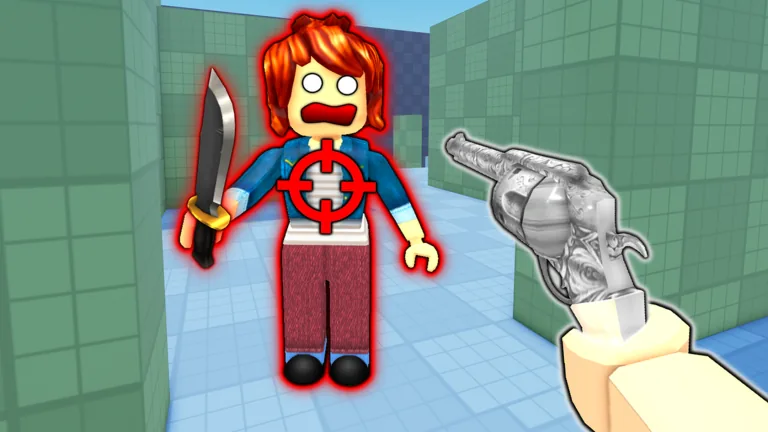
For better Murder Arena revolver aiming, place your view where an opponent could emerge before you step into a lane. Then make a small correction when someone appears. The official game image shows a first-person revolver aimed down a grid-walled corridor at a knife-carrying avatar. It gives you a useful situation to practice: you have one visible target, a limited opening, and another part of the arena outside your view. The goal is to keep your camera ready for both the shot and the space around it.
Hold your view near the next open edge as you approach a corner. If you stare at the floor or at a wall while moving, you must make a much larger correction when a player enters sight. A shorter correction is easier to control. This is an aiming habit you can practice without knowing the revolver’s exact damage, ammunition, or firing rate in the current build.
Give yourself a clean line before firing
An opponent crossing between two walls is easier to track when you can see the whole opening. If you stand too far behind a corner, the wall may cut off your view. If you step too far into the lane, you may expose yourself to more than one approach. Shift until you can see the opponent and still retreat behind the edge if a second player arrives.
Do this with small adjustments, not a long run straight toward the target. Watch how the target moves across your screen. When the movement is readable, center your view and take the shot at the moment you choose. If the opponent vanishes behind a wall, recover sight before making another commitment. A shot at where someone used to be is a poor substitute for an updated view.
The official image captures one revolver-versus-knife encounter, not a weapon range test. You can use its corridor shape to plan a sightline, but learn effective distances by watching your own live encounters. Do not assume that one screenshot tells you how every duel will play out.
| When you notice this | Try this camera adjustment | Why it helps |
|---|---|---|
| Your view rests on a closed wall | Move it to the next visible opening | You have less distance to correct when a player appears. |
| The opponent crosses the lane quickly | Track the crossing before committing | You see the direction of movement instead of guessing it. |
| Your target disappears around a corner | Shift for a fresh line of sight | Your next decision uses a current position. |
| A second player enters your side view | Widen your scan and reconsider the duel | The first target is no longer the whole fight. |
Separate your camera movement from your movement path
Your character may be moving along a corridor while your camera checks a side opening. That split is useful, but only if you know where the next wall is. Move a short distance, scan, and then move again. You should not need to stare at your feet to avoid the corner, and you should not rush blindly while trying to hold a precise aim point.
Spend one practice pass watching your camera placement instead of the result. As you travel, name the next two places where a player could appear. Keep your view on the nearer one until you have checked it, then shift to the other. In a free-for-all, no teammate covers the angle you ignore. This small exercise gives you a reason for each camera turn instead of constant, unfocused sweeping.
When you meet a knife-carrying player, use the same rule. Keep the player in view while checking whether your route stays open. You do not need to guess a fixed knife range or a guaranteed revolver advantage. Watch the gap and the walls that could hide an approach. If the gap closes faster than you can read the exchange, reposition rather than holding a camera angle that has stopped helping.
Reset your view after a shot or a duel
Many missed opportunities come after the first exchange. If you keep your crosshair on the last target’s position, another player can enter from the side unseen. Once the immediate threat has passed, turn toward the nearest unchecked opening. Only then decide whether to hold the lane or move. This post-duel scan matters in a lobby that can contain up to eight players, because several opponents may be moving at once.
If you missed, identify the camera error before blaming a weapon statistic. Was your view low when the target appeared? Did you overcorrect across the opening? Did you follow a player past a wall without updating your line of sight? Pick one error for the next encounter. Aiming practice becomes useful when you can name the correction and try it again.
Keep the check short. A live duel will not wait for a detailed review, but you can remember one cue: opening, target, side opening. Start with the place an opponent may appear, center on the visible target, and check the nearby approach after the exchange. That sequence keeps your revolver aimed with a purpose and leaves your camera ready for the next player.
FAQ
Where should I place my crosshair before a player appears?
Keep your view near the next opening you can actually see. That gives you a smaller correction when someone crosses it.
Does the official screenshot show the revolver’s damage?
No. It shows a first-person revolver encounter, but the image cannot show a damage number. Check the current game for that detail.
Should I keep tracking a player behind a wall?
Shift to regain line of sight. Use the player’s current position, rather than continuing to aim at the point where they disappeared.
What should I check after firing?
Check the nearest side opening and your route away from the lane. Another player may have moved while you focused on the first target.
How can I practice aiming without knowing weapon stats?
Work on camera placement before each opening, small corrections onto visible targets, and a quick scan after an exchange. Review one error at a time.