![Murder Arena [FPS] Wiki logo](/images/site/logo.webp)
Review the first decision you could change
After losing a duel in Murder Arena, look back to where the encounter first became difficult to read. Did you enter without seeing the side opening? Was your camera aimed away when the player appeared? Did you follow a target behind a wall after losing sight? Choose the earliest decision you can change and carry one correction into the next available fight.
This matters in a first-person free-for-all because the final exchange may be the result of an earlier position choice. If you stepped into a lane with no route away, better aim alone might not fix the situation. If your position was sound but your view rested on a closed wall, change your camera setup. A useful review separates those causes instead of treating every loss as the same problem.
Reconstruct the duel in three moments
Start with the moment before you saw the opponent. Where were you standing, and what openings could you see? Then remember the first clear view of the player. Did you have time and room to choose an angle? Finally, think about the point when the duel changed: perhaps another player appeared, the target crossed behind a wall, or your route was cut off. You do not need a replay tool to remember one strong cue from each moment.
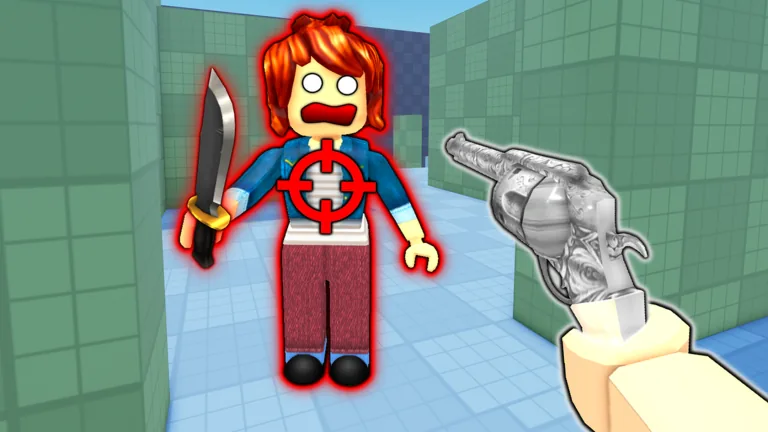
Use the grid-walled corridors in the official images as a visual example. A wall edge can give you a chance to check the next lane, but it can also hide movement. If you crossed that edge without looking, mark that as the first correctable step. If you checked it and still lost, look at how you tracked the visible player or whether a different route was available.
If you cannot verify a damage number, reload speed, or bonus in the current game, leave it out of your diagnosis. The official images show a revolver and a knife in encounters, but they cannot tell you why your particular duel ended. Reviewing what you saw gives you an action to test next time.
| First correctable moment | One next-fight test | What to watch |
|---|---|---|
| You entered a lane without seeing its side opening | Check that opening from a wall edge first. | Whether a player was already moving through it. |
| Your camera was pointed at the floor or closed wall | Hold the next open edge in view while moving. | How much correction you need when someone appears. |
| You followed a target after losing sight | Stop at the next readable corner. | Whether the target changed direction. |
| You held one position after a duel changed | Move to a fresh angle. | Whether the new view shows both target and exit. |
Test one correction in the next encounter
Pick one row, not all four. A single change lets you tell whether the practice helped. For example, if the problem was a blind entry, promise yourself only this: look into the next opening before crossing it. You may still lose the next fight, but you will know whether you carried out the new check. If you did, review the next earliest decision rather than abandoning the practice.
Keep the correction small enough to remember under pressure. “Play smarter” is too vague. “Scan the side opening after my first exchange” is an action you can perform. You can build a short series of these actions across several matches without claiming a fixed number of attempts or a guaranteed result.
If the opponent who defeated you is still visible, you may choose to fight them again. Murder Arena’s Revenge badge has a separate last-killer condition, but that goal need not decide your recovery routine. Ask whether the new encounter is readable. Chasing the same player through an unseen corridor may repeat the very position error you just found.
Return to the round with a current view
When you can act again, locate your current position and the visible openings before choosing a fight. Do not plan around an assumed respawn timer, fixed spawn point, or death penalty; check what the live match shows. Even if you remember where the prior duel happened, other players may have moved. Start from the scene in front of you.
Murder Arena allows up to eight players in a server. That gives you a reason to check for another entrant before focusing on the old opponent. One scan does not guarantee the lane will stay quiet, but it gives your next decision a better starting point. Then find a visible target and test the correction you chose.
At the end of a session, write down the cue that helped most: a corner check, a view held on the next opening, a shorter chase, or a better exit. Keep that cue for the next session. Recovery means turning one lost duel into a specific habit you can repeat, rather than letting the loss dictate the rest of the round.
FAQ
What should I review first after losing a duel?
Find the first decision you could have changed, such as entering an unchecked lane or losing sight of the opponent behind a wall.
Should I practice aim or positioning after a loss?
Choose the one that caused the earliest visible problem. A poor position can make an otherwise manageable shot much harder.
Does Murder Arena have a fixed respawn timer?
No fixed timer appears in the public game details. Use what the current match shows when you can act again.
Should I immediately pursue the person who defeated me?
Only if the new encounter is readable. The Revenge badge is a separate goal, and a blind chase may repeat the original mistake.
How many changes should I test at once?
Start with one concrete action for the next fight. That makes it easier to see whether the correction improved your decision.