![Murder Arena [FPS] Wiki logo](/images/site/logo.webp)
Choose the approach before you close the gap
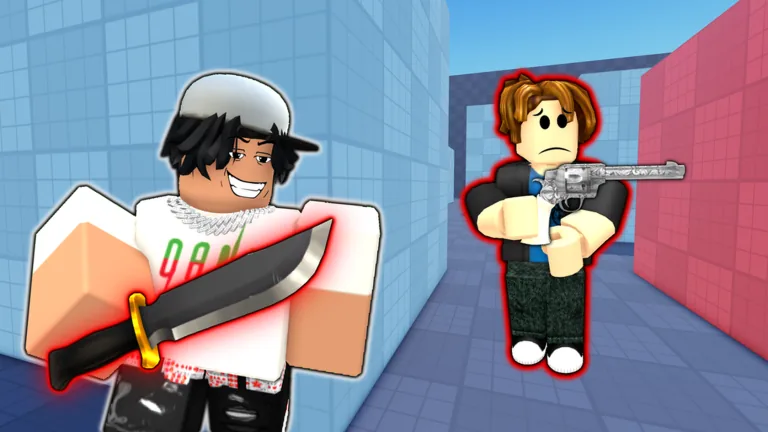
Murder Arena knife fights begin with a route choice. In the official images, a knife-carrying avatar faces a revolver user among grid-walled corridors. If you rush straight across a visible opening, you give that opponent a simple line to watch. Use the walls to reach a better angle, keep track of where the opponent went, and enter only when you can see the space you are entering. The image establishes the weapons in that encounter; it does not tell you their damage or exact reach.
Pause long enough to answer two questions: Where is the revolver user now, and which opening will expose you on the way in? If the answer to the first is uncertain, find a fresh view before continuing. If the answer to the second is an exposed lane, look for a different angle. You can make a quick choice without turning the approach into a slow crawl.
Treat every corner as new information
A wall can hide your movement from an opponent, but it also hides the opponent from you. As you round a corner, bring your view toward the next opening and be ready to change direction. The useful part of cover is the brief control it gives you over when you are visible. That benefit disappears if you step out without checking the lane.
Suppose you saw a revolver user cross behind a blue wall. By the time you reach that wall, they may have moved elsewhere. Follow the last sighting only as far as the next safe place to look. Then update your route from what you can see. This prevents a common mistake: treating the place where a player vanished as if it were still their position.
The colorful official image shows one knife carrier facing one revolver user, but Murder Arena is a free-for-all. Another player can enter the same corridor while you are focused on that pair. Check the side opening before committing to a close encounter. If a second threat appears, use the nearest wall to break up the exchange or choose another route. A successful approach depends on the whole lane, not just the first opponent you found.
| What you see | Better approach decision | What to avoid |
|---|---|---|
| A revolver user watches the long opening | Move to an angle with less direct exposure | Crossing the whole open lane on a guess. |
| The opponent disappears behind a wall | Recheck from the next readable edge | Assuming they stopped where you last saw them. |
| A second player enters the corridor | Reassess the route before closing further | Fixating on the original duel. |
| You reach a narrow opening with no clear exit | Look into it before stepping through | Committing to a space you cannot yet read. |
Close distance with a reason
If you have a knife in hand, shorter space can give you a chance to engage, but do not assume a universal advantage at a particular distance. Do not plan around a fixed reach, attack speed, or damage advantage unless you can verify it in the current game. Use the current encounter to judge whether you can actually reach the opponent, and keep an escape direction in mind if the angle changes.
Before moving in, decide where you will stop and look again. Use a wall edge or opening you can reach without losing sight of the route. Go there, check the opponent again, and only then decide on the final move. This creates a series of short decisions. A single long chase gives you fewer chances to notice a second player or a changed position.
When the opponent moves toward you, do not automatically continue forward. Watch whether that movement brings them into a readable space or draws you into a blind one. The gap itself is less useful than knowing where the exchange will happen. If the opponent backs away, follow only while you can see the next lane. A knife does not make uncertain corners safer.
Know when to leave the attempt
An approach can stop being good even after you committed to it. You may lose sight of the opponent, find another player in the lane, or reach a corner with no clear path out. In each case, return to the last position where you could read the space and choose again. Leaving an unclear attempt is a practical choice in a free-for-all, where someone else can arrive during the delay.
After a lost knife duel, review the first place where the route became unclear. Did you cross an opening while the revolver user could see you? Did you turn a corner after losing sight of them? Did you ignore another player’s movement? Select one of those moments to correct in your next approach. You can learn more from the entry decision than from replaying the final second of the fight.
Keep the cue simple: see, approach, check, commit. See the opponent’s current position. Approach a wall or edge that improves your angle. Check the next opening and any nearby player. Commit only while the route remains readable. That gives you a better basis for a knife fight than guessing how quickly you can cross a lane.
FAQ
Is the knife stronger than the revolver in Murder Arena?
The official images show both weapons, but they do not establish damage or a fixed matchup winner. Judge the current encounter by position and what the live game shows.
How should I approach a player holding a revolver?
Use a visible route between wall edges, update your view at each corner, and avoid crossing a long opening without checking the opponent’s position.
Should I chase a player who disappears behind a wall?
Go only as far as the next place you can look safely. Find their current position before choosing the rest of the route.
What if another player enters my knife duel?
Reassess the whole corridor. Use the nearest wall or another exit rather than continuing to focus on one opponent.
What should I review after losing a knife fight?
Find the first point where you lost sight of a player or entered an exposed lane. Change that approach decision on the next attempt.